Local authorities have decided to build a dam deep in Romania’s Giumalau Mountains. Before construction begins, Andrei, who works for the Suceava Prefectural Office, sets out alone to investigate a village in that area, which he last visited 20 years ago.
A short story by Ramona Taranu, a Romanian Noh researcher, writer, and translator.
by Kingyoya Editorial Department
“I’ve been to that village. The only reason I made it back alive is because of the people I encountered there. So there’s no way there isn’t a village in that valley. If it doesn’t appear on the map, then the map is wrong. Go deep into the mountains and you’ll see it’s there. Planning to build a dam without conducting a proper survey is irresponsible!”
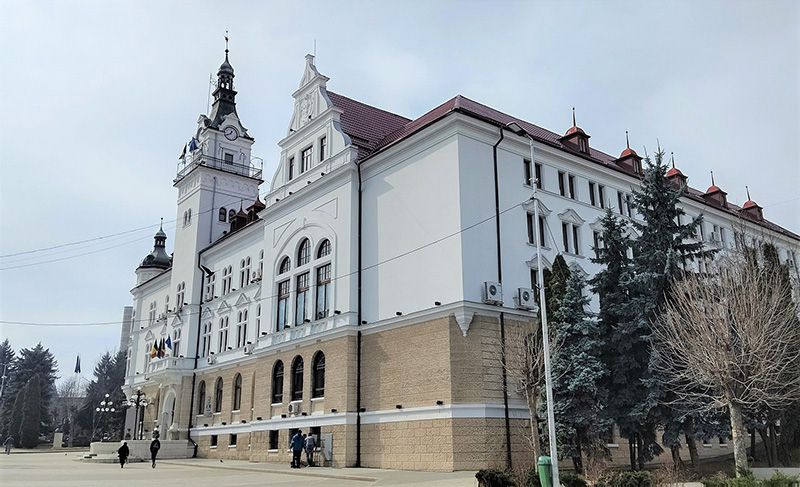
I once again brought up the Village by the Stream in a conversation with my superior, Gavrilet. The plan to build a dam deep in the Giumalau Mountains was steadily moving forward. Yet in the valley wedged between those three peaks, there ought to be a village where people are living. If a dam is to be built, the villagers would of course have to be relocated. And yet the prefectural office was on the verge of signing off on the planning documents for the dam—without ever having carried out a proper on-site survey.
“How many times do I have to tell you before it sinks in? There’s no record of any Village by the Stream in the prefectural archives. Besides, surveys for building a dam in the Giumalau Range started three years ago—every possible site should have been examined by now. No one lives in that valley. That’s precisely why it was chosen: it’s uninhabited and ideal for dam construction. Even the roadworks needed for the dam are simpler than dealing with land that requires relocating residents, and because no one lives there, a large tract of land can be secured. That’s why plans for a new tourist attraction—a dam museum—were approved as well. So will you please stop insisting there’s a village there?”
Gavrilet said this with an expression of utter weariness. Normally, he was a good-natured manager. He wasn’t much older than I was, and he had been friendly with me ever since I joined the Suceava Prefectural Office. I felt sorry for him—but I refused to back down.
“Of course, I’ve read that survey report, too. But don’t you find it suspicious? There aren’t any photographs, and that level of detail could have been written without ever going to the site. It’s not a peak you can climb easily, so I wonder whether anyone actually went there—either during the dam survey or the population census. I’m not opposed to building the dam. But what if there really is a village there? Before approving the plan, shouldn’t we conduct a proper on-site survey of the valley that will become the reservoir? That’s all I’m saying.”
Gavrilet looked up at me sharply over the rim of his glasses. As a prefectural official, he had a duty to ensure the safety of local residents. For a moment, the thought of what if seemed to cross his mind.
“All right—if you’re going to insist this much, we’ll go and investigate. But if there’s nothing in that deep mountain valley after all, you’ll be writing a formal apology. It’ll cost time and money, you know.”
“But if there is a village there, wouldn’t that be far more serious?” I insisted.
“All right. I’ll make the arrangements,” Gavrilet said curtly.
So at last, I was able to go and investigate the Village by the Stream.
*
On the day of the survey, I set out early in the morning in a prefectural government car with Gavrilet and his secretary. Gavrilet only said “Good morning” and then fell into silence, so I kept quiet as well.
I had assumed we would change trains at the station and head to the foot of the mountains, but instead the car stopped at an airfield on the city outskirts. A large helicopter was waiting there, along with three men wearing mountaineering boots. “Let me introduce you,” Gavrilet said, bringing me over to them. Two were officials from the Forestry Policy Division of the Ministry of Agriculture and Rural Development, and the third was an engineer responsible for the dam’s design.
Only then did I finally understand what Gavrilet had meant when he said, “This investigation won’t be easy.” As the deputy to the prefectural governor and the overall person in charge of the dam project, he couldn’t treat this as a quiet, internal inquiry—it had to be conducted officially and preserved as a public record.
I was taken aback by how serious the investigation had become, but Gavrilet simply gave my shoulder a light pat and said, “Shall we go?” So we boarded the large helicopter.
As the helicopter lifted into the air and the ground shrank away beneath us, I found myself absorbed in the scenery below, seen from the sky for the first time in a long while. It was a clear day, and I could see far into the distance.
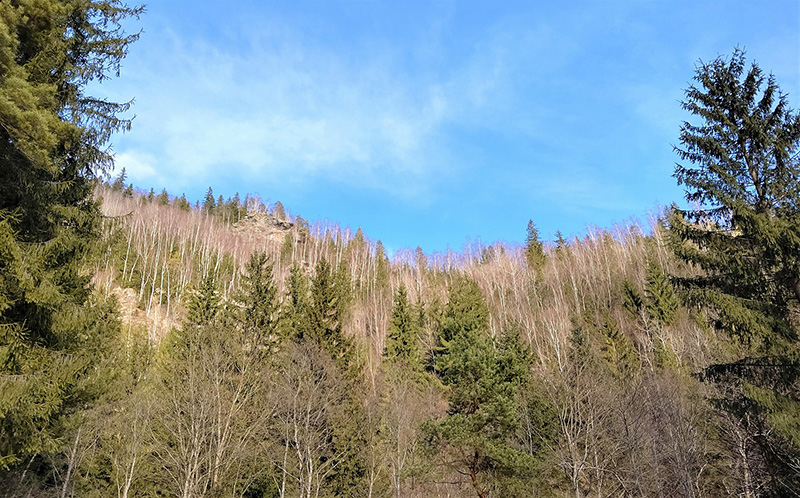
The helicopter climbed to an altitude of two thousand meters and cruised smoothly over the peaks of Mount Giumalau. At the summits, only a few rocks jutted out; there were no sharp points, just the gentle contours typical of folded mountains. Nothing grew there except low alpine plants.
Just below the summit, a forest of fir trees began. The helicopter followed the course of the river upstream toward its source. After flying for a while above rocks and treetops, a valley enclosed by three peaks came into view. The river’s current grew gentle within this valley, but near the wide valley’s outlet, the riverbed narrowed. There, the water pooled into a small natural lake, overflowed beyond the rocks, and plunged downward in a waterfall some forty meters high.
From the helicopter, it was easy to see how the rock wall at the mouth of the valley functioned as a natural dam. That was why the idea had arisen to build a dam here and construct a hydroelectric power station. Until now, we had relied on the Bicaz Power Plant in neighboring Neamt County for electricity, but as the populations of both counties grew, that was no longer sufficient. Suceava County had been forced to consider developing its own means of power generation.
The helicopter touched down beside the lake at the mouth of the valley. It was a cloudless, brilliant day, and the sunlight reflecting off the water was blinding. Once my eyes adjusted, I immediately looked around. A river ran along the valley floor, and tall grass grew thick and wild all the way to the fir forest at the foot of the peaks.
It was a very different sight from the valley I remembered, where grazed sheep had once wandered lazily, nibbling at the grass. As far as I could see, there was nothing that looked like a house.
“So, where is the village?” Gavrilet asked, gazing into the distance.
“It’s…” I replied, but the words failed me.
“We must have landed some distance away from the village. I’ll go and look for it.”
“One hour,” he said. “Be back here in one hour.”
He glanced briefly at his wristwatch, then walked off toward the members heading out to reexamine the waterfall.
I began climbing up the mountain along the river, aiming for the forest lining the side of the valley. However, pushing through the brushwood that grew as high as my waist proved impossible. I went farther upstream instead, hoping to find easier footing. The steep slope left me breathless as I stared down at my feet. When I finally lifted my head and looked toward the peaks, their outlines were unmistakably the same landscape I had known as a child.
Even though it was more than twenty years ago, I remembered the Village by the Stream clearly. The image was burned into my mind. About twenty houses stood scattered across the hillside. They were all roughly the same size, with white walls beneath thatched roofs. The pillars supporting the roofs were carved with beautiful patterns. Only the households that kept sheep or cattle had, in addition to the main house, barns and storehouses for the animals.
Near the forest stood a church surrounded by seven fir trees, and within its grounds there was a school. I had even been inside the school once, led there by my friend Cristi.
But when I reached the top of the hill, gasping for breath, there was nothing there. Wherever I looked, all I saw was grass. I couldn’t believe that in the span of twenty years, the village could have vanished without a trace.
I searched for the spot where the church had stood. Even if the villagers had moved elsewhere and the houses had fallen into ruin, the church was a large building—something should have remained. And the cemetery, too. Behind the church, there had been a cemetery. The one Grandma Sofia used to visit every day to light candles at the graves—perhaps that, at least, had survived after the villagers left.
When the Bicaz Dam was built in neighboring Neamt County, the residents of several villages were forced to relocate. Houses, churches, shops, and schools were dismantled, transported, and rebuilt in new villages—but the cemetery posed a problem. Everyone recoiled at the thought of disturbing the graves. Yet they could not allow the remains of their loved ones to be submerged beneath the dam.
After long debate, it was finally decided that the coffins would be exhumed and reburied in the cemetery of the new village. The people of the Village by the Stream would have faced the same choice. If a cemetery still remained here, it would have to be relocated before it was swallowed by the reservoir.
I quickly found the seven fir trees that had once marked the church. But no matter how thoroughly I searched around them, there was nothing. No fragments of church walls, no fence from the cemetery, not a single cross—nothing remained. I bent down, then sank to the ground, parting the grass with my hands. I couldn’t believe that even the foundation stones would be gone. But they were. Nothing.
Unable to move, I just stood there on the hill. When I glanced at my watch, I saw that the hour Gavrilet had given me had long since passed.
As I trudged back down along the river, Gavrilet’s voice echoed throughout the valley: “Andreeeei, come back heeere—hurry uuuup!”
I waved to him and quickened my pace.
“Did you find it?” he asked as soon as I returned.
“No. There’s nothing there. But I’m certain there was a village here.”
I braced myself for a scolding. Even if it was “just to be safe,” the investigation had become a major operation—we had chartered a helicopter and brought along officials from the Forestry Policy Division. If there really was nothing, it would indeed mean a formal reprimand.
But Gavrilet didn’t raise his voice.
“You feel better now?”
His low, quiet voice caught me off guard.
“Feel better…?”
“Look, there is no village here. I’ve been meaning to tell you this for a while, but ever since the dam project began, you’ve been a bit off. You don’t seem like yourself—restless, strangely impatient. I don’t know the reason, but don’t you think you might be exhausted? This project has been grueling work. Why don’t you take some time off? Take a proper break, let your mind and body rest, and then come back to work.”
Gavrilet spoke as if gently admonishing me. It was a shock to hear such words from him—the person at the office I was closest to, the one I trusted most. When I searched my own feelings, it was strange: I felt as though there might be something there, and yet nothing I could clearly grasp.
Still, I couldn’t bring myself to ignore his words. Without thinking, I asked, “Do you really think I should go on a break?”
“Absolutely, please do” Gavrilet said firmly.
I decided to take leave from the office. Even so, I simply couldn’t believe that the village didn’t exist—that it had never existed at all.
*
Since I had hardly ever taken paid leave since starting work at the prefectural office, applying for it all at once gave me a full two weeks off.
It was true that I had gone on the official survey and failed to find the village. But I had only been there for a few hours. I couldn’t think otherwise than that a village existed in that valley. Perhaps I had wandered into a similar-looking place by mistake. I decided to devote my two weeks of paid leave to searching for the Village by the Stream.
In order to retrace my memories from twenty years ago more accurately, I decided to visit Dorna Arini, the village where my grandfather lived. “You’ll finally see your grandfather again,” my wife Ioana said, her face clouded with worry.
She looked as though she wanted to come along, but someone had to look after our still-young son, Sebastian. I reassured her again and again—“I won’t do anything dangerous”—and once she was at ease, I packed three days’ worth of clothes and a small gift for my grandfather. Then, early in the morning, I set off by car toward the mountains to the west.
It had been a long time since I last visited Dorna Arini. The only time I had been there in recent years was when Ioana and I brought newborn Sebastian to meet him—and that had already been three years ago.
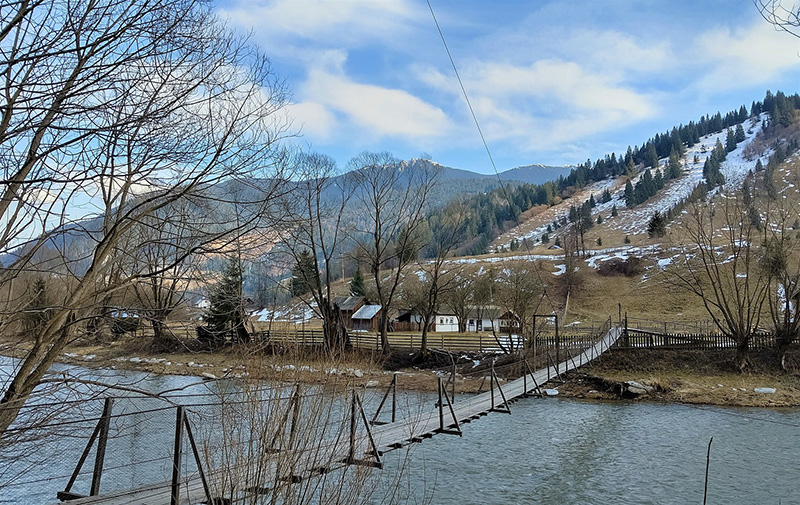
As I entered Dorna Arini, surrounded by mountains and forest, the village’s handsome local houses came into view. Many of them were new and modern, and compared to the past, life for the villagers seemed far easier and more comfortable. Half of the mountain rising beyond the village, too, was considered part of Dorna Arini.
Surrounded by mountains and forest, Dorna Arini was the place where my father had been born and raised, and as a child, I had loved spending my summer holidays there. But it was also the place where my father had died in a mountain fall.
Living in the city made it easier not to think too much about that tragedy, yet from time to time, the pain of the accident would return, sharp as a stab. For that reason—though I felt sorry toward my grandfather—I had somehow drifted away from Dorna Arini over the years.
My grandfather’s house stood at the foot of the mountain, far from the center of the village. When I parked the car, opened the gate, and stepped into the garden, my grandfather—who had been smoking on the veranda—caught sight of me and rose to his feet. He hurried over, exclaiming, “Oh, Andrei!” and pulled me into a tight embrace.
“Sorry it’s been so long, Grandpa.”
“Don’t worry about it. Ioana and Sebastian are doing well, right?”
“Yeah—they’re fine.”
His wrinkles seemed a little deeper than before, but he was the same gentle grandfather I remembered. “Go on and put your things down first,” he said, and I stepped inside the house for the first time in years.
Everything was just as it had always been. On the back wall hung an icon of the Virgin Mary and the child Jesus, a candle flame flickering before it. On the table by the window, bread wrapped in a linen towel lay where it always had. Along the opposite wall stood my grandfather’s bed and the stove. To the right of the entrance was a shelf for dishes and the like, with a television perched on top—still in use, but an astonishingly old model. Beneath the grape-colored blanket spread over the bed, a clean, white pillow showed through. The room smelled of basil, just as it always had.
My grandfather was neat by nature, and the house was carefully kept, but since my grandmother passed away, it had become a lonely place for one person to live.
I went into the guest room. Since I had called ahead, my grandfather had neatly made the bed for me. Photographs were displayed by the window. The pictures of Ioana, Sebastian as a newborn, and me were in color, but my father’s photograph was black and white.
Seeing my father in the picture—his mustache, the smile that only I seemed to recognize—sent a sharp pain through my chest.
Stepping out onto the veranda, I found the evening air pleasantly cool. My grandfather poured orange juice he had bought at the village shop into a glass and offered it to me.
“As I mentioned on the phone,” I said, “I need to look into something related to the dam.”
“Ah, the dam,” my grandfather replied. “I’ve heard about it from the people at the town office. They said our way of life won’t change any—but who knows.”
“Nothing will change here. The Bistrita will keep flowing along the same riverbed. What I’m worried about is a village deep in the mountains—the village of those mountain people who once saved my life when I was a child.”
“Ah,” my grandfather murmured, and fell silent. When I was young, he would listen patiently as I talked about the village, nodding along. But as I grew older, he had begun to avoid the subject, and that had always left me uneasy and dissatisfied. After all they had done for me…
“You believed me, didn’t you, Grandpa? When I went missing in the mountains—and then came back alive three weeks later—I told you it was because the people living deep in the mountains had taken care of me. Grandma didn’t believe me. Mom didn’t either. Only you did.”
“All I know,” my grandfather said slowly, “is that you came back from the mountains alive. For that, I thank God. But as for the people here—no one has ever met anyone from that mountain village. No one at all knows anything about it.”
“But there really was a village deep in the mountains,” I said, putting force into my words.
“Aye, that may well be so,” my grandfather replied. “Long ago, there may have been people living deep in the mountains. My father—your great-grandfather—used to say that on the surface of the Corbu stream, he once saw the shells of red Easter eggs floating by. Every spring, he said, red eggshells would come drifting down from the mountaintops. He used to say that somewhere deep in the mountains, there might be believers in Christ just like us, living their lives there.”
“I’ve heard that story too,” I said.
“Your father used to say that someday he wanted to look into it as well. And the fact that you were saved—that was thanks to God and your late father.”
My grandfather said this as he followed the smoke from his cigarette with his eyes as it rose into the darkening sky.
My father had left the village to attend a high school in the city, but even as an adult, he had been deeply drawn to stories of the village hidden deep in the mountains. He spoke to me several times about those legends. I had sometimes wondered whether he had gone into the mountains to investigate the village and fell from a cliff—but the truth was something I would never know.
The next morning, when I casually said, “I’m heading into the mountains,” my grandfather stopped me with an unusually firm, “Don’t.”
I was at a loss. I had come to Dorna Arini in the first place to draw up, from the depths of my memory, the path that led to the mountain village I had once reached twenty years earlier.
But Ioana had asked me not to do anything dangerous, and now my grandfather was stopping me as well. I had long since given up on plunging deep into the mountains to search for the village itself. Still, I wanted at least to see the entrance to that place with my own eyes. After promising my grandfather that I would go only as far as the valley at the foot of the mountains—and would absolutely not climb the peaks—I was finally able to set out.
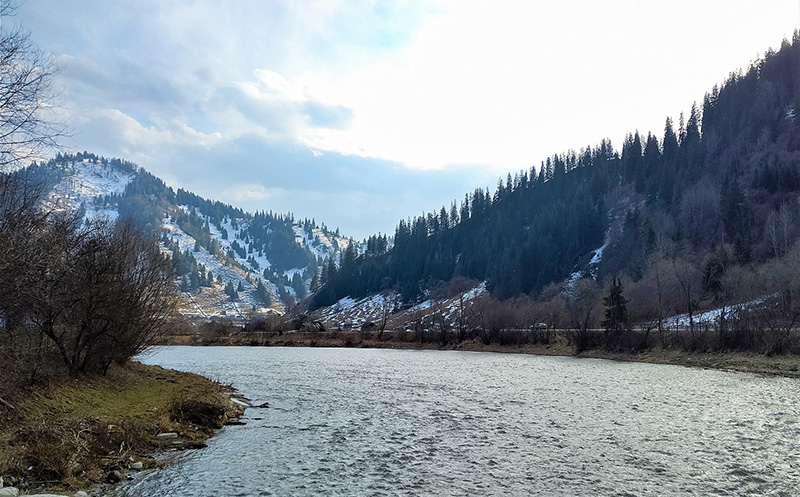
The Bistrita River, which flows across the Eastern Carpathians from west to east, strikes the hard rock at the foot of Mount Pietrosul near Dorna Arini and then bends northward. Joined by tributaries flowing down from the peaks of Mount Giumalau, it grows into a larger river and carves its way southeast through the rock between Giumalau and Pietrosul. This area is the Zugreni Gorge, one of the Carpathians’ most scenic spots and a popular destination for casual hiking.
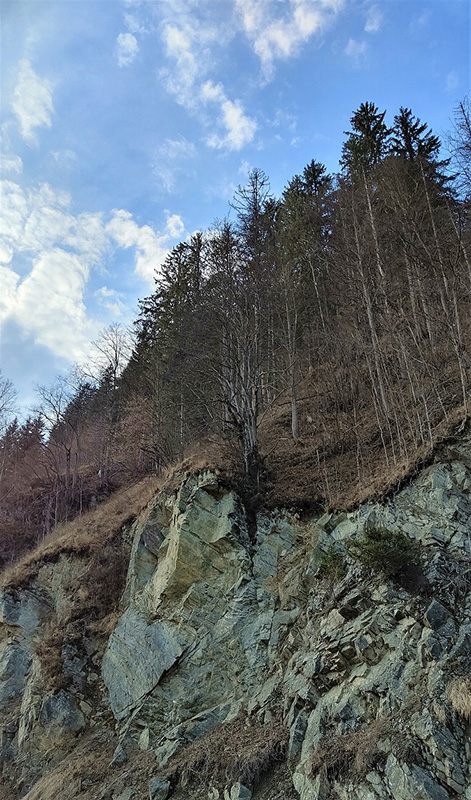
One of the small rivers flowing into the Bistrita is the Corbu River. Leaving the confluence behind and climbing along Corbu’s beautiful gorge, you enter the rich forests of Mount Giumalau. The trail here is steep, with small, moss-covered rocks forming natural steps. Through the fir forest, the slender peak of Mount Rarau comes into view. Without the sound of the Corbu’s flowing water, the mountains would be wrapped in complete silence.
It wasn’t very deep in the mountains yet, so I had been here several times as a child. Back then, my father used to bring me along. I was fascinated by stones of unfamiliar colors and shapes, and by rare flowers blooming in the shade of the fir trees. My father would explain the mountain plants to me in detail, as well as the animals that appeared in a flash and vanished just as quickly.
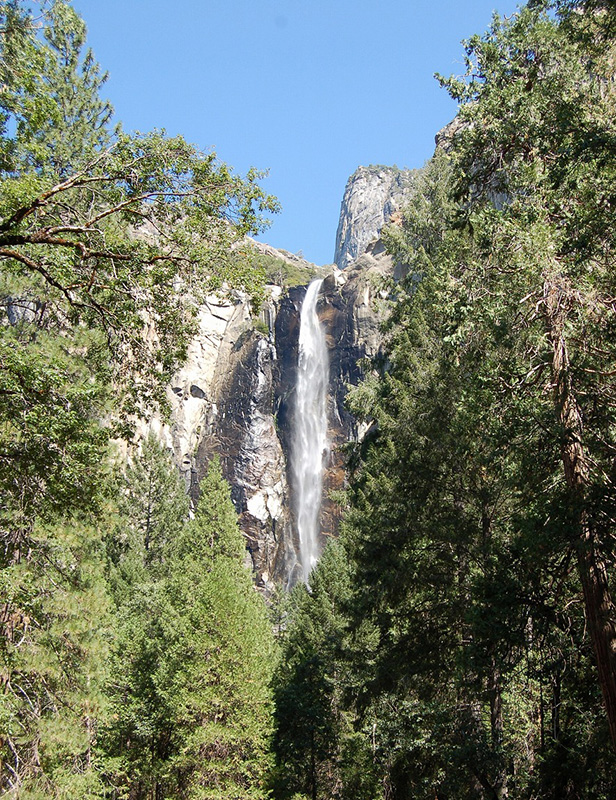
Further into the mountains, that sound reached me from afar. It was a thunderous roar that made my heart jolt every time I heard it. The crash of Urlatoarea Falls was known locally as “the growl of hell.”
“This is it,” I murmured.
There was no doubt—this was the entrance to the village.
But the waterfall was a sheer wall of rock that seemed to reach all the way to the sky, and there was no path leading upward from here. When I had suffered my fall in this area and later said that the people of the mountain village had helped me, the villagers from Dorna Arini carefully searched for a route up above—but they found none. I was told that they had been unable to find the mountain village either.
And yet, I had been carried from here to that village, and then come back down from it. I had gone back and forth between this waterfall and the mountain village above. The path had to exist—it simply hadn’t been found. And the village had to exist as well.
I had come to this waterfall only once before, led here by my father. He explained it as if the falls were something mystical: “The Corbu must flow from behind that peak. Right above us, another river joins it and becomes this waterfall. The sound is incredible, isn’t it? That’s why it’s called Urlatoarea, the “Screaming Falls”.”
The reason my father had brought me here was to show me a cave behind the waterfall. There had been a path leading to it, but now a tall iron fence blocked the way, with a No Entry sign hanging from it. I could have climbed over it if I wanted to, but I forced myself to hold back. I had promised both Ioana and my grandfather that I would not do anything dangerous.
A short distance from the iron fence stood a low stone memorial. Everyone knew that the Urlatoarea Falls was dangerous. Yet it had always been a place that irresistibly drew people in. What my father had been seeking—what he had come here to investigate, or whether it had simply been a reckless adventure—I would never know. Why he had come alone to this waterfall remained a mystery.
Several names were engraved on the plaque of the memorial—those who had lost their lives here. My father’s name was among them.
I crouched in front of the memorial and placed my hand over my father’s name. The cold of the stone seeped into my skin. A sharp pain stabbed my chest.
It was already past noon. Being deep in the mountains, the temperature kept dropping steadily. After pressing my hands together once more in front of the plate bearing my father’s name, I began my descent. By the time I passed through the Zugreni Gorge, dusk had fallen.
I casually pulled my phone from my pocket and saw that Ioana had called me several times.
“Why couldn’t I reach you?!” she shouted.
“Sorry, I had no signal,” I said.
“Don’t tell me you went into the mountains. After I asked you not to do anything dangerous…”
Even if I told her I hadn’t done anything dangerous, she didn’t sound like she was ready to calm down.
“I just went as far as the place where my father fell,” I said. “It was like visiting his grave.”
That finally seemed to ease her anger a little.
“When are you coming back?”
Her tone had softened, just slightly.
“I’ll stay at Grandpa’s place tonight, but I’ll be back by tomorrow evening. If I make it in time, I’ll pick Sebastian up from daycare too.”
“Good, then we have a deal,” she said. “This is where you belong. You have us now.”
“I know,” I replied.
I was at a loss for words and fell quiet.
“So, what do you want for dinner tomorrow night?”
Ioana suddenly said it in a bright, cheerful voice.
“Anything’s fine…”
“I’ll make you something special.”
I burst out laughing. Ioana would corner me like this from time to time—but she always led me back into the light.
“You’ll be back by evening, right? Don’t be late.”
When I ended the call, darkness had completely settled around me.
Ioana’s words—You have us now—rose again in my mind, blending with Gavrilet’s voice: You’re acting strange.
“That’s not true,” I said, shaking my head.
I only wanted to help the people of the mountain village who had saved my life. If they had been forced to move elsewhere, I wanted to know they were safe. Until I had an answer, I couldn’t stop my investigation.
*
After returning from Dorna Arini, I began going to the city library every day. I wanted to gather even the smallest fragment of information about the mountain village.
I started with books on the Giumalau Mountains—mountaineers’ memoirs, histories of the towns and mountain villages in the surrounding region, and even specialized works on the mountains’ natural ecology and geology. From morning until the library closed in the evening, I immersed myself in reading in the reading room. Yet nowhere did I find any record of the village. I could not believe that my own memories were mistaken. The village must truly lie—or must once have lain—hidden in a remote wilderness, far from human habitation.
As I worked my way through the roughly ten books I had checked out on Giumalau, one by one, I noticed that among them was a book I had no memory of ordering. Printed on the cover were the words Collected Folk Songs of Bukovina by Simeon Florea Marian. I began reading it and found it fascinating. It was a scholarly work compiling the folk culture of the Bukovina region from a hundred years ago. A great many folk songs had been collected and carefully organized by category—songs sung during farm work, songs for the Sunday hora dance, songs for weddings and funerals. There were many poems about trees, flowers, mountains, rivers, and the sky, and it was clear how deeply the people of this region had lived as one with nature.
When I read a poem titled “Funeral Song for the Unmarried,” my heart gave a jolt. I was certain I had heard this song in the village by the stream—heard it sung aloud by a wailing woman.
My child, you have gone away.
A star was set upon your brow.
You were wed to the fir tree
and carried up into the sky.
The angels welcome you as a beloved sister—
they sing in celebration.
Shine like a star,
singing with them forever,
watching over us.
If, before the gate of heaven,
should you come to greet me,
I would be so glad.
Let us meet again there.
Wanting to know what was happening, I followed the crowd of people heading for the cemetery together with Cristi and little Marioara. We pushed our way forward between the adults’ legs.
Inside the coffin lay a young girl dressed in a pure white wedding gown. Her face was very peaceful. At her head, the priest intoned his prayers, while at her feet her mother, clothed in black, offered her prayers through violent sobs.
Women gathered around the mother, weeping as they sang. Their words overlapped with the words in the book, and within me they became sound, became song, swelling loudly inside my chest. I saw Uncle Nicolae approaching with a frightening look on his face.
“Come now, go and play over here.”
Uncle Nicolae took us by the hand and led us out of the crowd. A sharp clanging sound rang out beneath the blue sky. It must have been the sound of nails being driven into the coffin.
I heard the mother’s sobs rise louder than all the others. But the adults stood in the way, and we could no longer see anything at all.
I hurriedly read the annotation.
“A song heard in a village at the foot of the Giumalau Mountains. In the deep mountain region, the line ‘shining like a star’ appears instead as ‘shining like the moon,’ but there are no other differences.”
The deep mountain region—that had to mean the village by the stream. There was no doubt about it. My heart raced. For the first time, I had found a tangible clue to the village’s existence. Without thinking, I sprang to my feet.
“Excuse me—this book… who collected it, or rather, who handed it to me?”
The middle-aged librarian behind the counter gave me a puzzled look.
“Is there some kind of problem?” she asked.
“No—it’s just that I don’t remember borrowing this book, but it somehow ended up mixed in. Still, it helped me tremendously. I wanted to say thank you.”
“Ah, then it must have been some sort of mistake,” the librarian said with a look of relief, flicking her gaze toward the back. “Maria,” she called.
“Yes?”
A young woman turned around. She looked to be about a university student. As she approached, I saw the name badge on her chest: Maria Filip — Trainee. She had large, blue eyes.
“About this book—I don’t think I borrowed it. But it was incredibly helpful. It gave me exactly what I was looking for. You’re the one who handed it to me, aren’t you?”
“Ah—”
Maria let out a quiet, knowing smile.
“You’ve been checking out nothing but books about Mount Rarau and the Giumalau range for days now, haven’t you? Hardly anyone borrows books like these, so every time I’ve had to go all the way to the back of the storage room to look for them. This one was on the same shelf as the books you requested, so I thought it might be of some use and slipped it in.”
“I see. Thank you very much.”
“If you don’t mind me asking—what exactly are you researching?”
A bright, curious light shone in Maria’s eyes. I hesitated for a moment, then answered, “I’m looking into a village located deep in the mountains of Giumalau.”
“Oh?”
After a brief pause, she said, “Was there really a village that far back in those mountains?”
“There is—no, there was. I think.”
“Have you actually been there?”
“I have,” I said, my voice sharpening.
“That’s fascinating,” she said. “I’m studying folklore at university, and I’m also working toward my librarian certification. I’ve never heard of a village deep in the Giumalau mountains before. If you don’t mind, would you tell me about it? It might be useful for a folklore paper.”
Maria smiled mischievously.
I hesitated, but almost at once decided that I would try telling her. When I was a child, I had told the story over and over again to my mother and grandparents, but since becoming an adult, I had never fully unearthed all those memories. I thought that by speaking to Maria, I might be able to put them in order.
“This is my last day of training,” Maria said. “I finish work at noon, so I’ll have some time in the afternoon.”
We decided to talk together in the library’s group reading room.
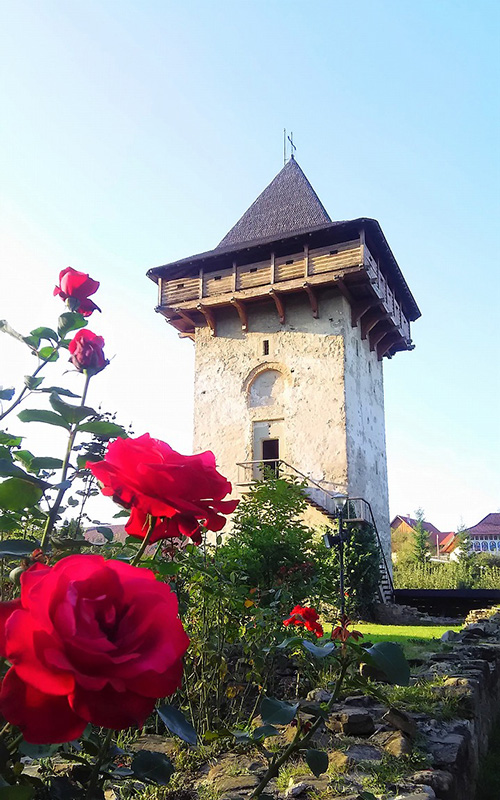
In the reading room, a white table stood in the center of the space, and through the window, I could see the tower of the monastery across the road.
“All right, I’m ready,” Maria said.
She opened a pristine white notebook on the table, its pages still blank, and took up her pen.
It felt a little like an interrogation, which made me smile, but I began to speak about my memories from long ago.
*This translation from the Japanese into English was created using AI technology, and subsequently reviewed and edited by the original author of the story.
 縦書きでもお読みいただけます。左のボタンをクリックしてファイルを表示させてください。


■ 金魚屋 BOOK Café ■

■ 金魚屋 BOOK SHOP ■